The Queue Before the Doors Opened
On the morning of August 28, a line had already formed outside Stakke, a venue in Seoul's Seongsu district, before the doors to a two-day beauty showcase opened. The event, co-hosted by Mission International and Stakke, was built for rising K-beauty brands to present their products alongside sessions and buyer-investor networking, and it drew roughly 500 attendees from among beauty brand staff and industry specialists. That queue is a small, verifiable data point in a story that otherwise runs heavy on ambition and light on disclosed numbers.
What K-Beauty Express Actually Is
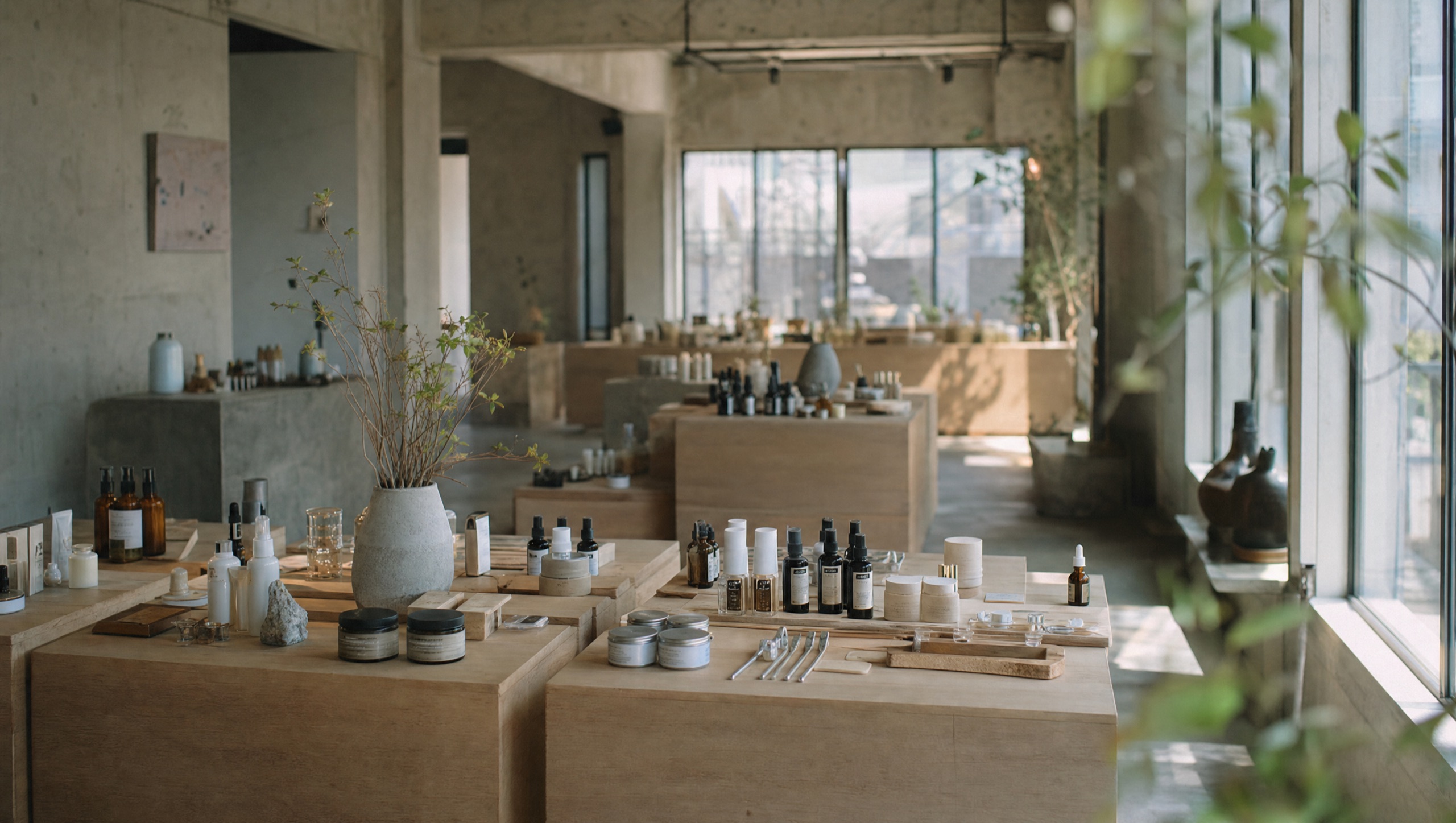
K-Beauty Express 2.0 was not a trade fair in the Cosmoprof or in-cosmetics sense — no vast exhibition halls, no thousands of booths. It compressed three functions into one Seongsu weekend: a ground-floor popup market where shoppers could buy directly from founders, an upstairs program of growth sessions, and structured networking with buyers and investors. The first-floor popup featured eight brands selling directly to visitors, including NU BARE, NIANDO, and THE LOVA, while the second floor ran sessions on contract and IP issues for brand protection, survival strategy after going viral, managing manufacturing lead times, and overseas logistics strategy. Other brands present, per event materials, included CISL, ODDLY COMBINED, tokki, EPODE, and the Everyday Wonder line — English-language brand names are used here consistently, since Korean-script renderings varied across sources.

A Law Firm's Bet on Cross-Border Beauty
The organizer behind the "Mission International" name is not a beauty company. It is the international arm of Mission Law Firm, a Seoul-founded practice that has built its identity around startup and venture-investment law. Mission Law Firm launched in 2021 with six lawyers and has grown into a roughly 32-person organization with a footprint spanning Seoul and several U.S. cities including Silicon Valley, Los Angeles, San Diego, and Atlanta. It became the first Korean law firm to open a Silicon Valley office, in 2023, specifically to support venture capital firms and startups expanding into the U.S. The firm also serves as official legal advisor to Korea Venture Investment Corp and the Seoul Vision Fund. That pedigree explains why a beauty showcase's second floor read more like a legal clinic than a marketing seminar — the sessions on contracts, IP, and cross-border logistics are the firm's core competency applied to a new vertical.
The Differentiation Problem
The organizing premise behind the event, echoed across founder conversations at similar Seongsu gatherings, is that "Korean-made" alone no longer separates a new skincare brand from the next one. Manufacturing speed and access to contract manufacturers have leveled out across the industry, so founders increasingly compete on more specific ground: which actives they use and how they're sourced, how they frame efficacy claims for clinical or recovery-focused positioning, what a formulation actually does in a category like sun care, and — increasingly — in what order they attempt market entry. That last point matters more than it sounds. A brand that tries Europe before it has budgeted for compliance paperwork can burn through a year's runway on documentation alone.
The other structural pressure feeding events like this one is cost. A solo Seongsu popup — rent, buildout, staffing, PR — is expensive for a brand that hasn't yet proven demand. Clustering eight brands under one law-firm-backed event splits that cost and adds a built-in buyer and investor audience, which is a plausible explanation for why cluster-format showcases keep appearing rather than each brand going it alone.
Numbers Worth Trusting
Individual brand revenue, funding, or team size for the eight participants could not be independently verified and are not used here. What can be verified is the macro picture around them. Korea's cosmetics exports hit a provisional $11.43 billion in 2025, a 12.3% increase over the prior year, marking a third consecutive year of record exports after $8.46 billion in 2023 and $10.18 billion in 2024. That pushed Korea past the United States into second place globally for cosmetics exports, behind France — France recorded $24.3 billion, Korea $11.4 billion, and the U.S. $10.8 billion. On the demand side, Grand View Research estimates the global K-beauty products market at $118.3 billion in 2025, projecting growth to $129.2 billion in 2026 and $252.4 billion by 2033 at a 10.0% compound annual growth rate. Those figures describe the category's tailwind. They say nothing about whether any specific brand at Stakke will still exist in eighteen months — that distinction is the whole point of separating verified market data from brand-level claims.
The European Paperwork Nobody Budgets For
Sun care, derma-cosmetics, and clean-beauty positioning are the categories where European buyers show the most appetite for Korean brands right now — but Europe is also where regulatory cost is most likely to blindside an early-stage founder. Under EU Regulation (EC) No 1223/2009, every cosmetic product must be notified in the Cosmetic Products Notification Portal before it can be sold in the EU, and only a Responsible Person based in the EU can complete that notification. A Korean brand, being outside the EU, has to appoint an EU-based importer, agent, or consultancy to serve as that Responsible Person. That role isn't a one-time filing — it carries ongoing obligations for the entire time the product stays on the EU market, a scope of accountability many brands underestimate. A safety report from a qualified assessor and a maintained product information file sit underneath that, per product, before a single unit legally ships.

Where Korea, Europe, and Switzerland Diverge
The three markets referenced around this showcase don't behave the same way, and treating them as one "global expansion" plan is where unit economics tend to break. Korea functions as the test bed — a single Seongsu weekend generates real purchase behavior and buyer feedback at low cost. Europe rewards derma, sun care, and clean-beauty positioning, but only after the Responsible Person and CPNP costs are priced in up front, not discovered mid-launch. Switzerland is narrower still: a high-purchasing-power market suited to premium clinical and sleep-wellness positioning, sitting outside the EU but bound by comparable labeling logic — products typically need text in German, French, and Italian, plus a locally accountable party, a compliance line item that's easy to skip in a pitch deck and expensive to skip in practice.
What to Check Next
None of this confirms that any of the eight brands from Stakke will convert a popup weekend into durable distribution. What's observable, for anyone tracking this rather than betting on it: whether these brands' future EU-bound packaging lists a named Responsible Person and address, which is a public, checkable compliance signal rather than a marketing claim. Whether any of the eight reappear as exhibitors at Cosmoprof, in-cosmetics, or Indie Beauty Expo in the next cycle — repeat B2B presence is a cheap proxy for real buyer traction. Whether Mission International runs a 3.0 edition, and whether the brand list turns over entirely or shows repeat names, which would say something about which founders actually converted the networking into deals. And whether any brand discloses a funding round or retail placement through a named, checkable source — until then, the honest position is that the market-level numbers are solid and the brand-level story is still unwritten.